Launch offer — valid today only

📄 Digital book in PDF · read it on your phone or print it

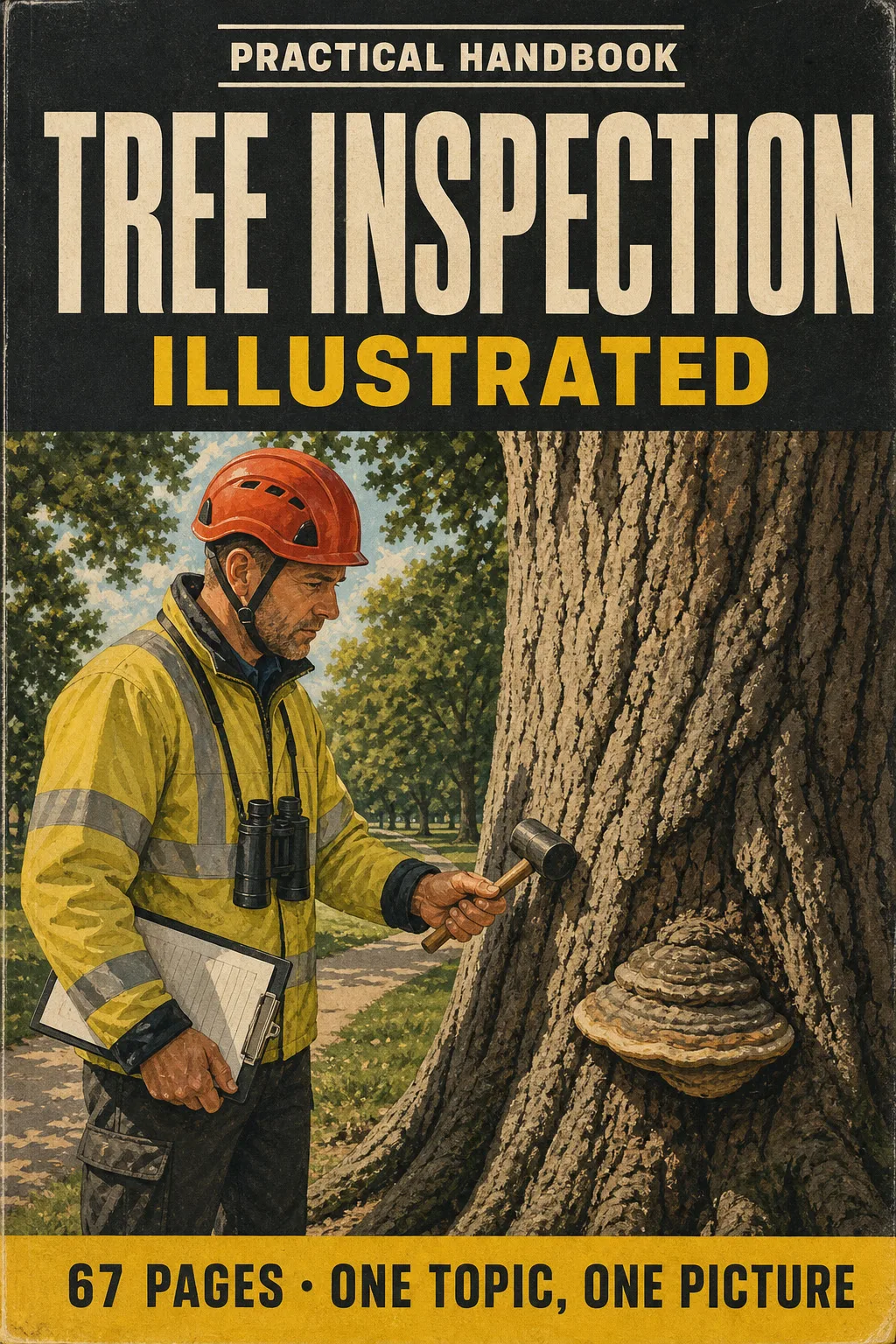
UK Tree Inspection, Defects and Decay Fungi in Drawings One Topic on Every Page

For the Professional Tree Inspection assessment and for anyone who inspects trees in the UK: duty of care, root plates, included bark, cavities, decay fungi with their hosts, ash dieback, tree risk and the written report. Each topic has its own page: first the drawing, then what you need to remember. 67 illustrated pages.

GET THE 67 ILLUSTRATED PAGES

🔒 Secure checkout · PDF by email · 30-day guarantee

Every topic, its own pageEvery defect and fungus drawn, with the explanation beside it
67 illustrated pages9 parts, from duty of care to assessment day revision
Up-to-date sourcesOccupiers' Liability Acts, NTSG guidance and BS 5837:2012
PDF by emailFormat

Look Inside the Book

Every page has a large drawing and a box with the rules, numbers and steps you need to know:

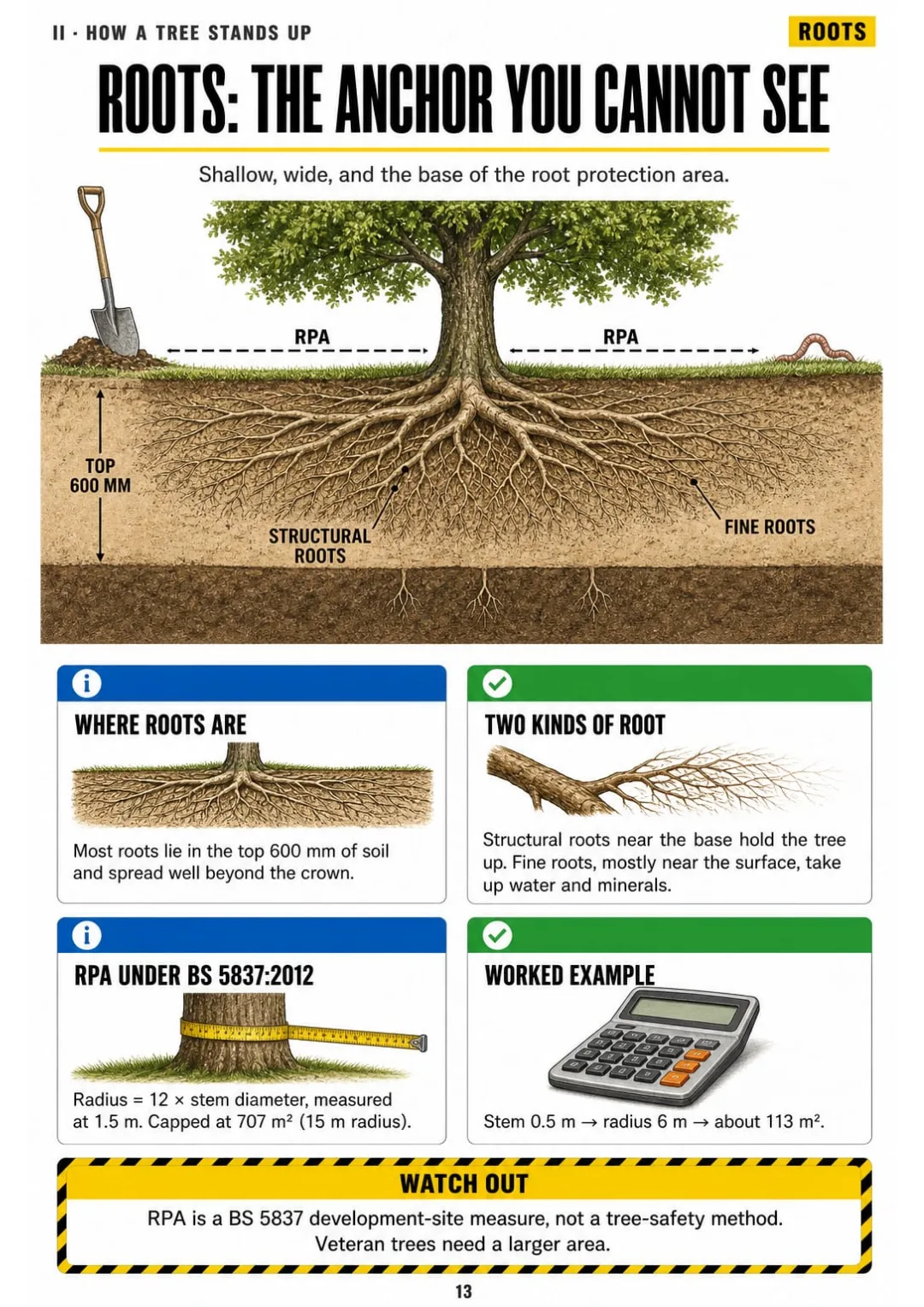
RPA radius = 12 × stem diameter at 1.5 m: a 0.5 m stem gives 6 m and about 113 m².
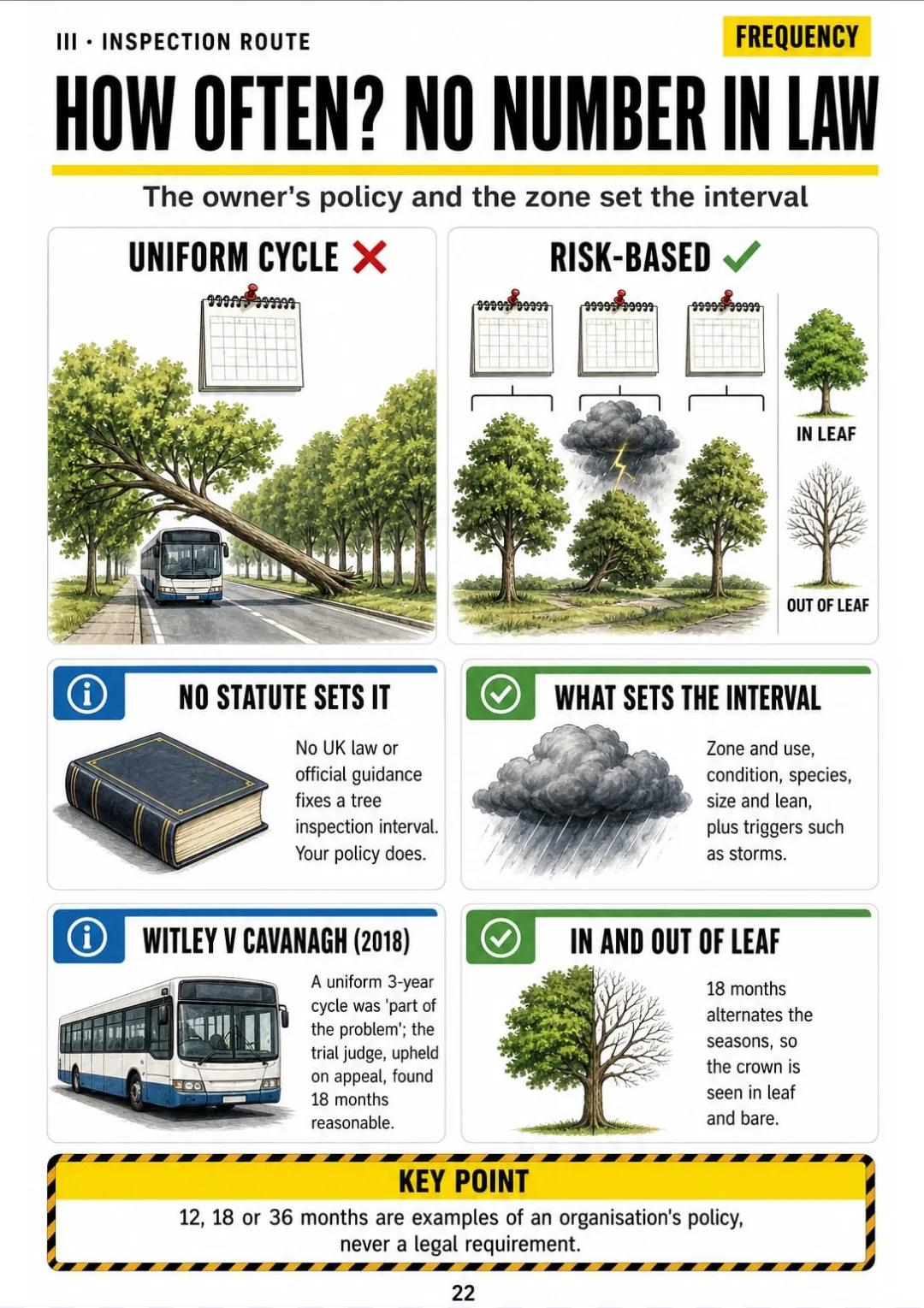
No fixed interval in UK law: Witley v Cavanagh (2018) criticised a uniform 3-year cycle
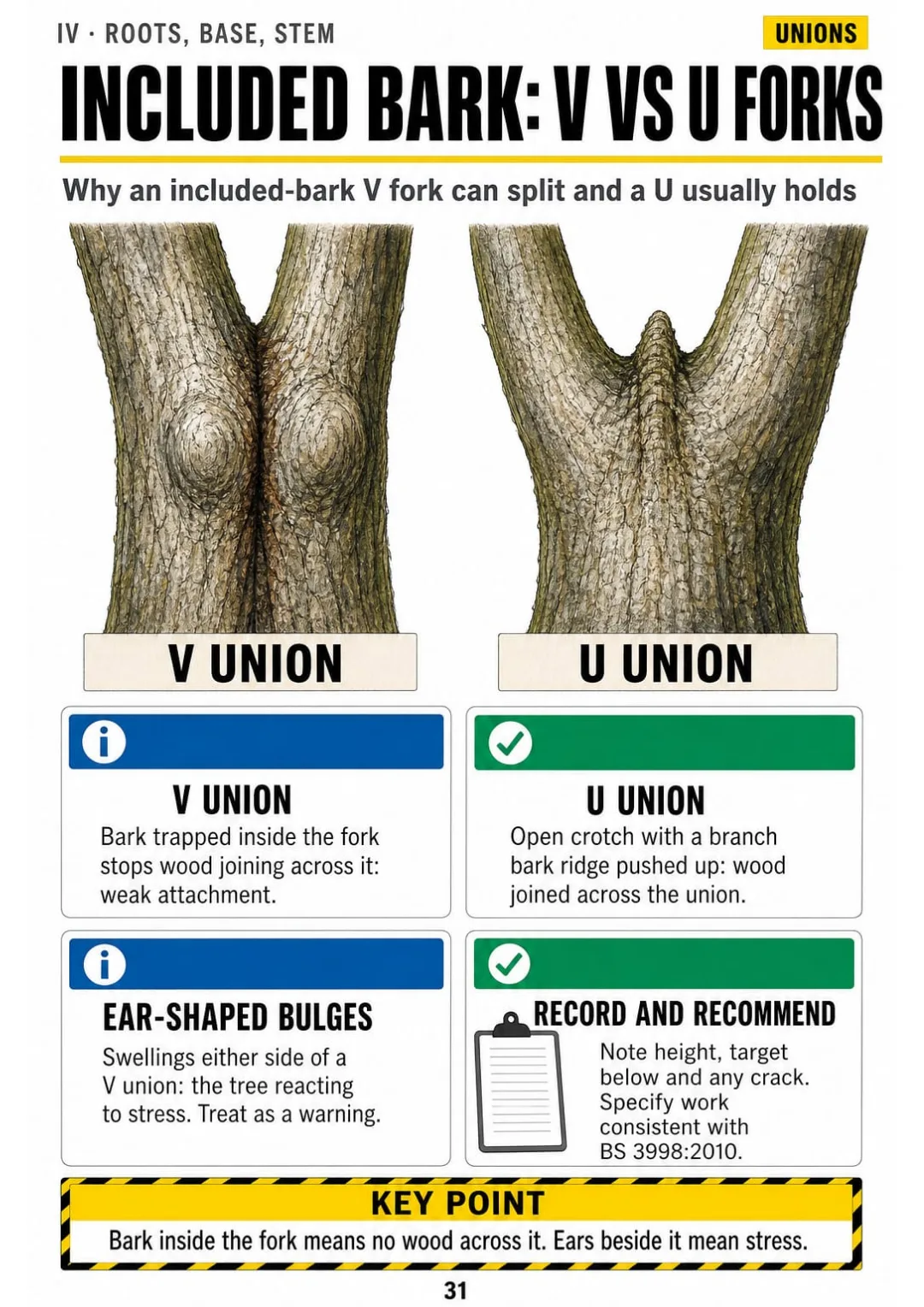
V union with included bark vs U union with branch bark ridge.
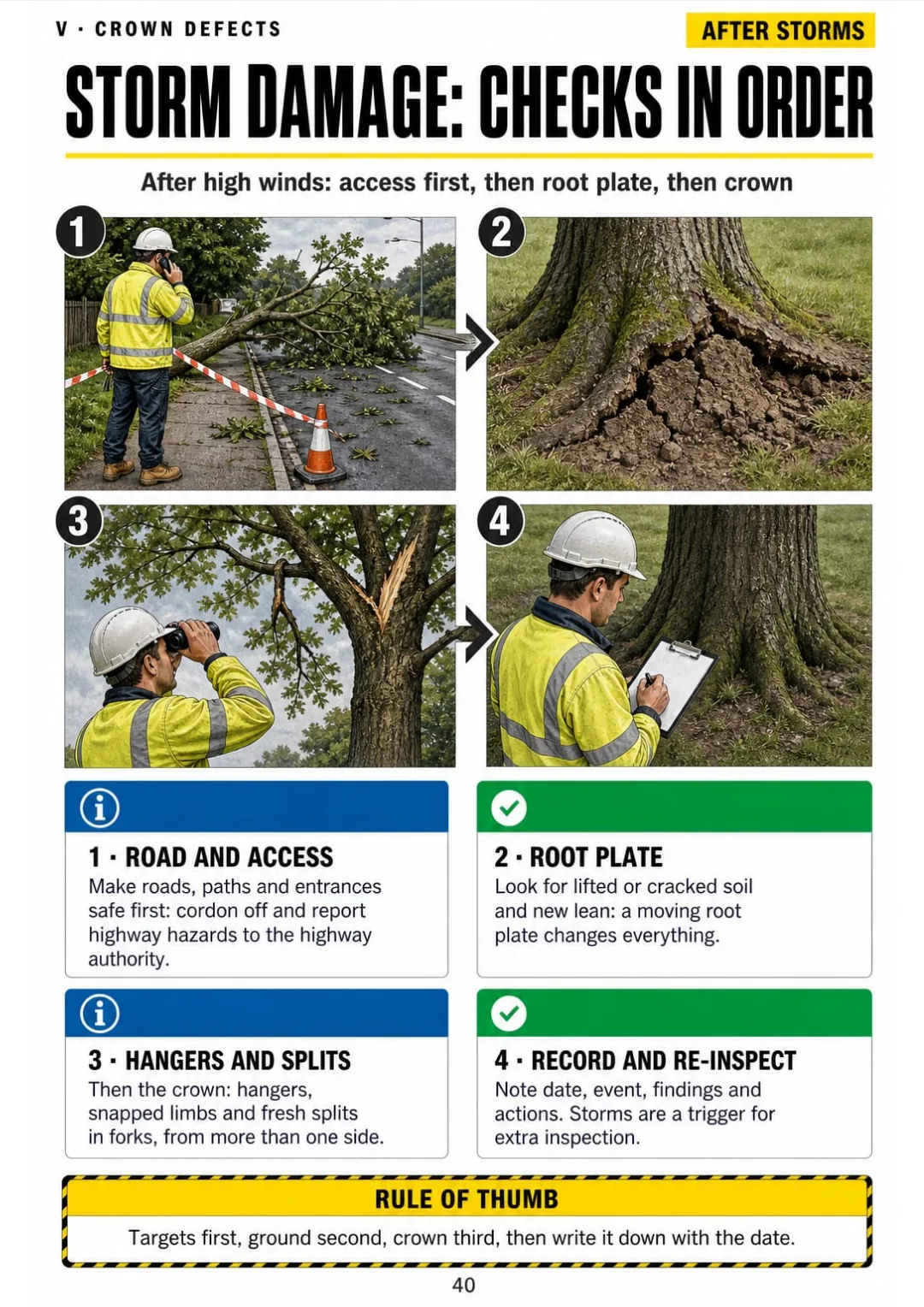
Four after-storm checks, always in the same order
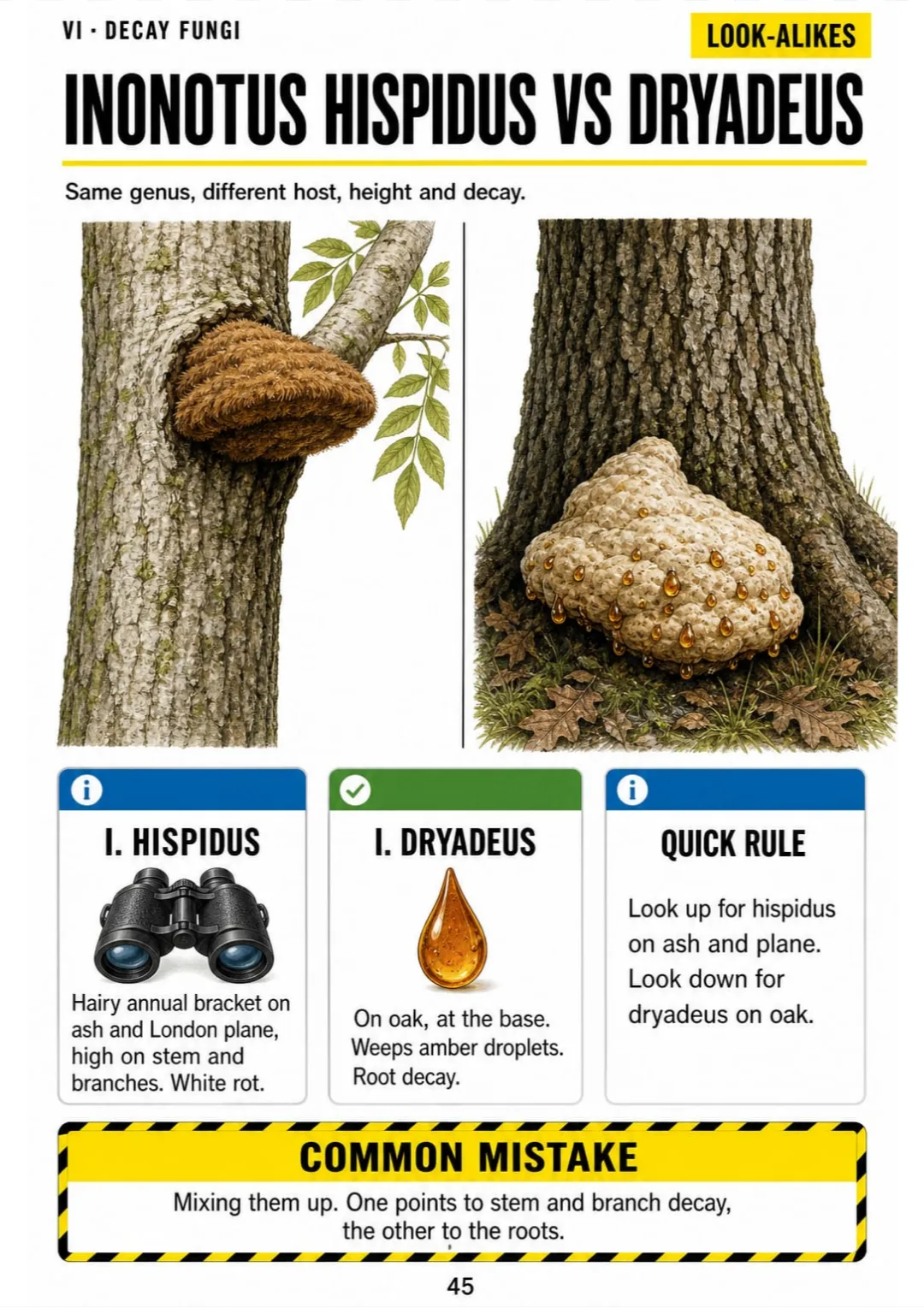
Inonotus hispidus: hairy, high, ash and plane. I. dryadeus: oak base, amber droplets.
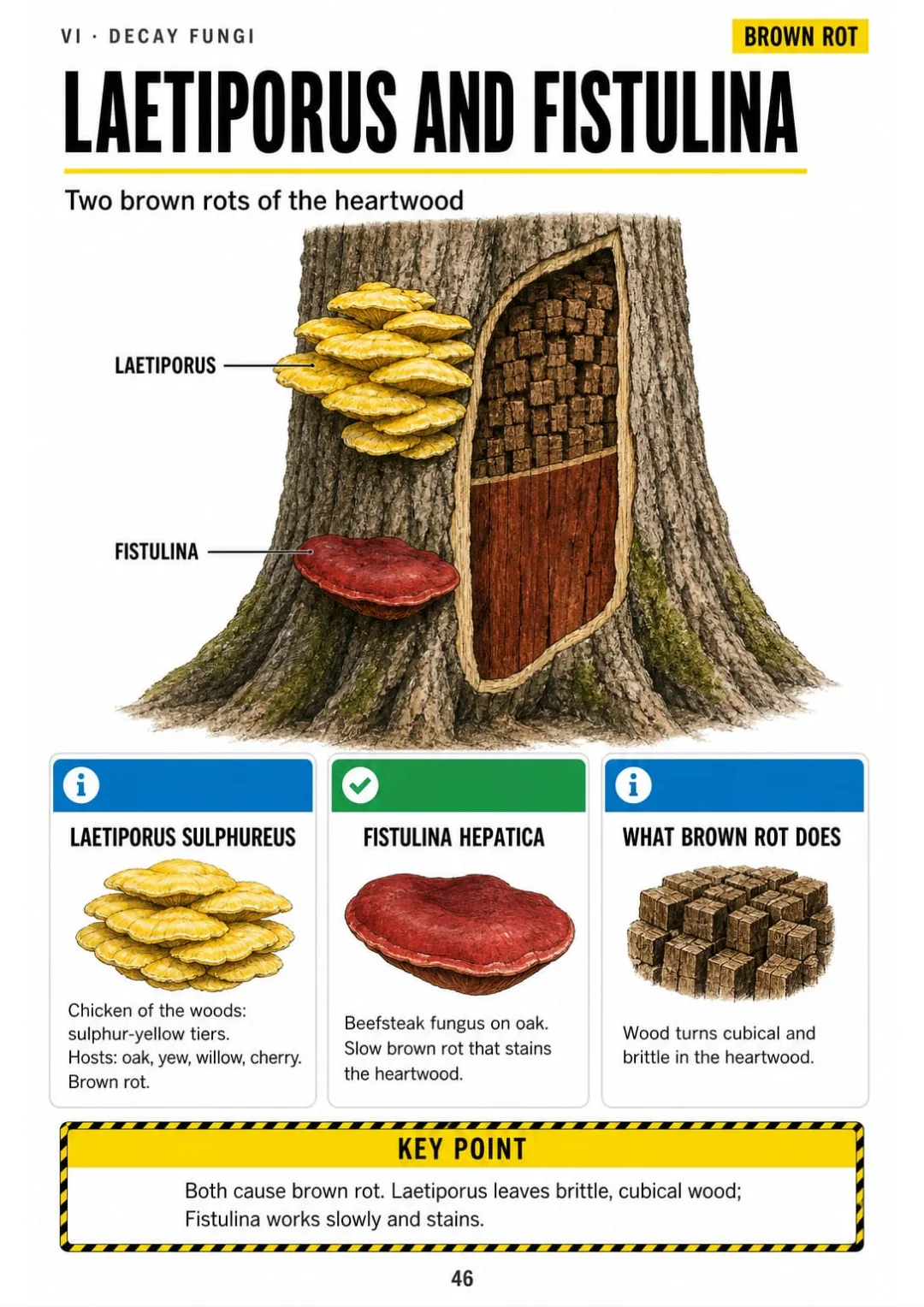
Laetiporus and Fistulina: two brown rots of the heartwood, mainly on oak.
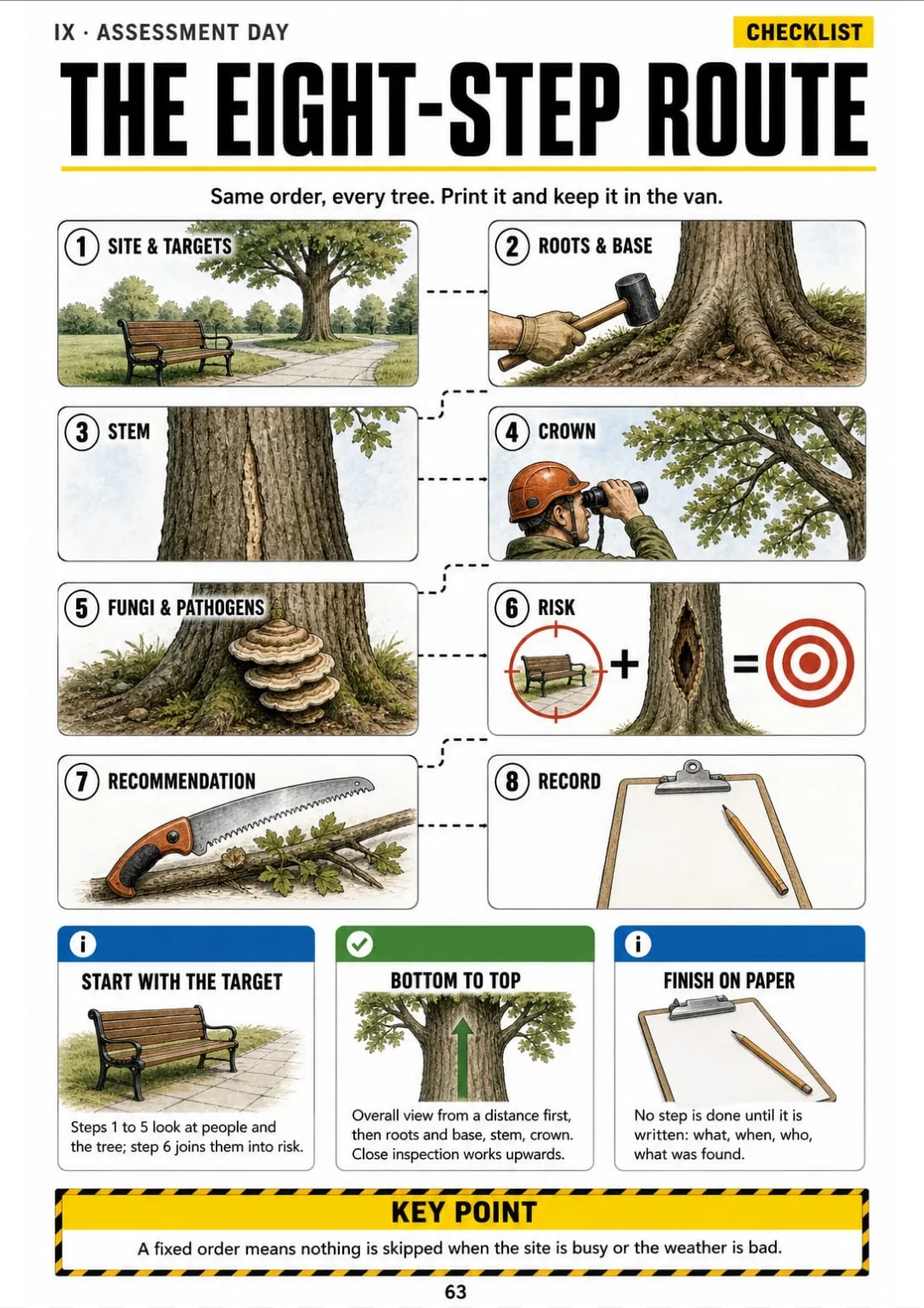
The full inspection route on one printable page: 8 steps, site to record.
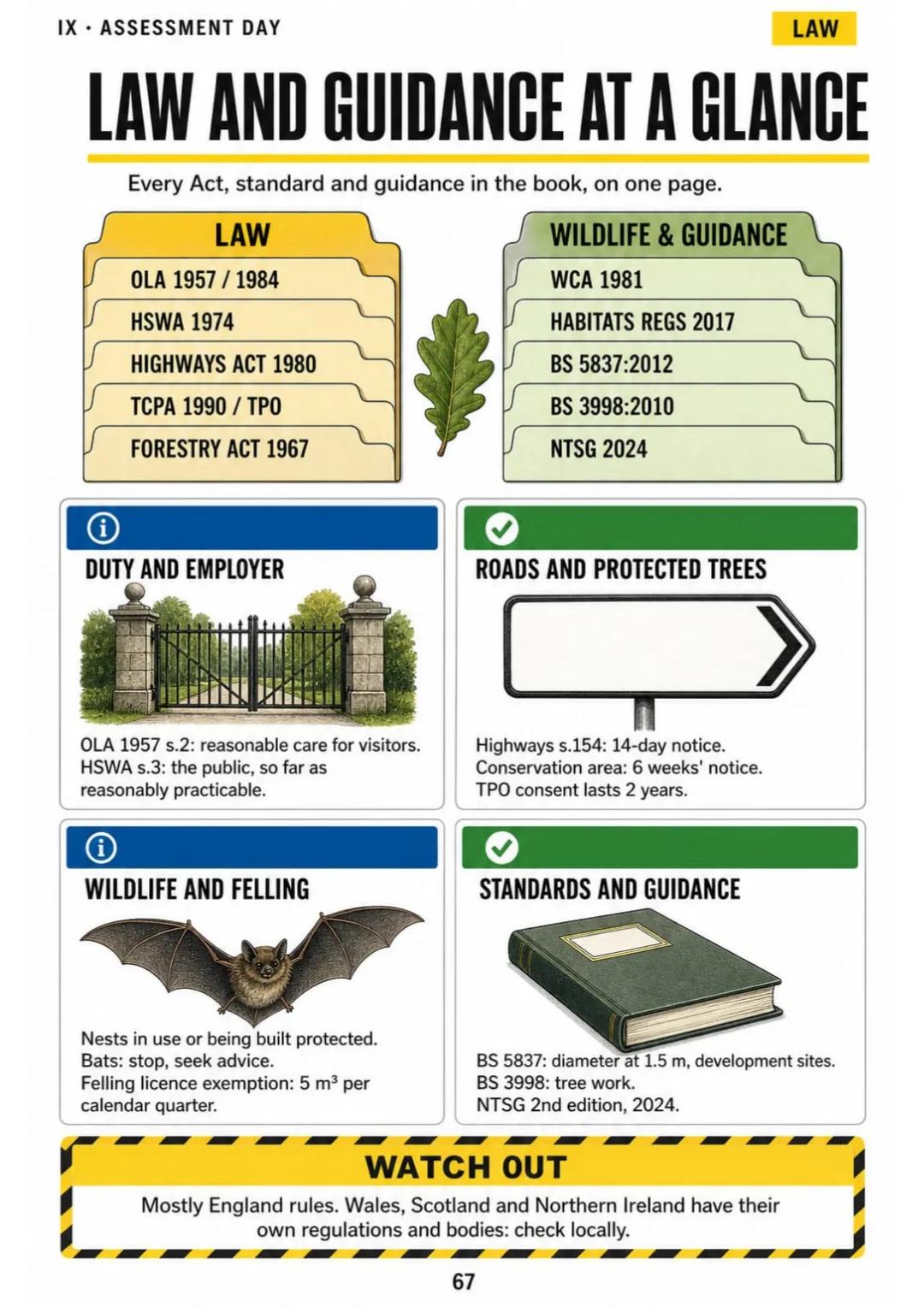
One-page table: OLA, HSWA, Highways Act, TPO, wildlife, felling, BS 5837, BS 3998, NTSG.

Swipe to see more →

These are real pages from the book. The table of contents is the full one: 9 parts and 63 topics.

The Problem Isn't You. It's How It Was Explained.

You're standing under a twin-stemmed sycamore, two big leaders meeting tight at the fork, and you have to say whether that union is a defect. You've seen hundreds of them, but now it has to go down in writing.

The course notes give you half a page on included bark, compression forks and branch bark ridges. It's all paragraphs, and none of it shows you what the union actually looks like.

V union with included bark vs U union with branch bark ridge.

In the book, that fork is one page: a tight V union with bark trapped inside, drawn next to an open U union with its branch bark ridge. Two drawings side by side, and what each one means for the tree.

Cavities and the t/R ratio, corrected and uncorrected lean, Kretzschmaria at the base, hangers in the crown, re-inspection dates: each one has its own page, drawn the same way.

You look at the fork, you know what you're seeing, and you write it down without going back to the notes.

COMPARE FOR YOURSELF

The Same Topic, Two Ways to Study It

THIS
  • The manual: line after line
  • Inspection intervals explained only in words
  • You reach the assessment with doubts
Neither the Occupiers' Liability Acts nor the Health and Safety at Work etc. Act 1974 prescribe a specific interval between tree inspections. The frequency should be determined by the duty holder having regard to the nature and intensity of site use, the species, age and condition of the trees, and the foreseeable consequences of failure. In Witley Parish Council v Cavanagh (2018), the Court of Appeal considered whether a uniform three-year cycle was adequate for a tree beside a busy road, and found that it was not.
FOR THIS
  • The inspection interval in one drawing
  • The case law and the factors in a box
  • You see it and you get it
No fixed interval in UK law: Witley v Cavanagh (2018) criticised a uniform 3-year cycle
CONTENTS

Take a Look at the 9 Parts and 63 Topics

Duty of care and the law, how a tree stands up, the inspection route, root, stem and crown defects, decay fungi with their hosts, pests and pathogens, risk and the report, and assessment day revision: 67 pages, all illustrated.

IDuty of care and the law · pp. 5-11
  1. Why trees are inspected: reasonable, not risk-free
  2. Occupiers' Liability Acts 1957 and 1984
  3. Health and Safety at Work Act 1974 and the employer
  4. Highways, neighbours and roadside trees
  5. Case law the inspector should know
  6. Tree Preservation Orders and conservation areas
  7. Wildlife, bats, nesting birds and felling licences
IIHow a tree stands up · pp. 12-18
  1. Inside the stem: bark, phloem, cambium, xylem
  2. Roots: the anchor you cannot see
  3. Reaction wood and adaptive growth
  4. Body language of trees: reading the shape
  5. CODIT: how a tree walls off decay
  6. Vitality vs structure: two different questions
  7. Age classes and species profiles
IIIThe inspection route · pp. 19-24
  1. The fixed route: eight steps, every tree
  2. Zoning the site by target and use
  3. Levels of inspection: informal, basic, detailed
  4. Inspection frequency: no fixed number in law
  5. The kit for ground-based inspection
  6. Measuring and recording the basics
IVRoots, base and stem defects · pp. 25-33
  1. Root plate movement and soil heave
  2. Root damage, severance and soil compaction
  3. Buried root collar and girdling roots
  4. Lean: corrected vs uncorrected
  5. Cavities, hollows and the t/R ratio
  6. Cracks, seams, ribs and bulges
  7. Included bark and co-dominant stems
  8. Wounds, cankers and bark damage
  9. Stem decay: signs you can see from the ground
VCrown and branch defects · pp. 34-40
  1. Deadwood: size, position and target
  2. Hangers and broken branches
  3. Weak branch attachments and over-extended limbs
  4. Regrowth after lopping, topping and pollarding
  5. Crown dieback and thinning
  6. Inspecting in leaf and out of leaf
  7. Storm damage and after-event checks
VIDecay fungi with their host trees · pp. 41-50
  1. How to read a decay fungus: three questions
  2. Ganoderma at the base
  3. Meripilus giganteus on beech
  4. Kretzschmaria deusta: the black crust
  5. Inonotus hispidus and Inonotus dryadeus
  6. Laetiporus and Fistulina: brown rot in the heartwood
  7. Polyporus squamosus and Rigidoporus ulmarius
  8. Armillaria: honey fungus
  9. Birch, conifer and ash specialists
  10. Fungi map: host, position, rot type
VIIPests and pathogens · pp. 51-56
  1. Ash dieback
  2. Oak processionary moth and oak health
  3. Horse chestnut and London plane problems
  4. Phytophthora and root pathogens
  5. Dutch elm disease, sooty bark and bark beetles
  6. Notifiable pests: what to do when you find one
VIIIRisk, recommendations and report · pp. 57-62
  1. The three parts of tree risk
  2. Reasoning likelihood of failure
  3. Risk assessment methods used in the UK
  4. Recommending the work
  5. Priority and re-inspection dates
  6. Writing a report that stands up
IXAssessment day revision · pp. 63-67
  1. The eight-step route on one page
  2. Fungi and pathogen identification checklist
  3. Practical inspection: what to do on the day
  4. Most frequent mistakes in inspection records
  5. Legal and guidance quick reference

One Page, One Topic, All Clear

Think of it this way:

A beech on a school boundary has a black, crusty patch at the root flare, and the head teacher wants to know today whether the path beneath it stays open.

In the book you open the Kretzschmaria page: the crust drawn grey in spring and black later, the soft rot at the base, and the trees it usually turns up on.

Inonotus hispidus: hairy, high, ash and plane. I. dryadeus: oak base, amber droplets.

The same goes for Meripilus on beech, included bark, root plate heave, ash dieback and re-inspection dates: each one on its own page.

Tree Inspection Illustrated is 9 parts and 67 illustrated pages, one topic on each, with an assessment day revision part at the end: the eight-step route on one page, the fungi checklist and the law at a glance.

What you see drawn, you don't have to memorize.

What's Inside Tree Inspection Illustrated:

Ipp. 5-11

Duty of care and the law

Why trees are inspected, the Occupiers' Liability Acts, the HSWA and the employer, roadside trees, key case law, TPOs, conservation areas, wildlife and felling licences.

IIpp. 12-18

How a tree stands up

Bark, cambium and xylem, roots as the anchor, reaction wood, the body language of trees, CODIT, vitality vs structure and species profiles.

IIIpp. 19-24

The inspection route

The fixed eight-step route, so no part of the tree gets skipped: zoning by target and use, levels of inspection, how often to inspect, the kit and what to measure and record.

IVpp. 25-33

Roots, base and stem defects

Root plate movement, root damage and compaction, girdling roots, lean, cavities and the t/R ratio, cracks and bulges, included bark, wounds and stem decay.

Vpp. 34-40

Crown and branch defects

Deadwood, hangers, weak attachments, regrowth after topping and pollarding, crown dieback, in-leaf and out-of-leaf checks and storm damage.

VIpp. 41-50

Decay fungi with their host trees

Name the bracket and know what it means: Ganoderma, Meripilus, Kretzschmaria, Inonotus, Laetiporus, Fistulina, Polyporus, Rigidoporus and Armillaria, each with its hosts, plus the fungi map on one tree.

VIIpp. 51-56

Pests and pathogens

Ash dieback, oak processionary moth, horse chestnut and London plane problems, Phytophthora, Dutch elm disease, sooty bark and notifiable pests.

VIIIpp. 57-62

Risk, recommendations and report

From what you saw to what you write: the three parts of tree risk, likelihood of failure, UK risk methods, recommending the work, priorities, re-inspection dates and the written report.

IXpp. 63-67

Assessment day revision

The eight-step route on one page, the fungi and pathogen checklist, the practical inspection, frequent record mistakes and the law in one table.

At the end of the book: An assessment day revision part, the eight-step route on one page and the law and guidance in one table.
Plus: 2 Free Books

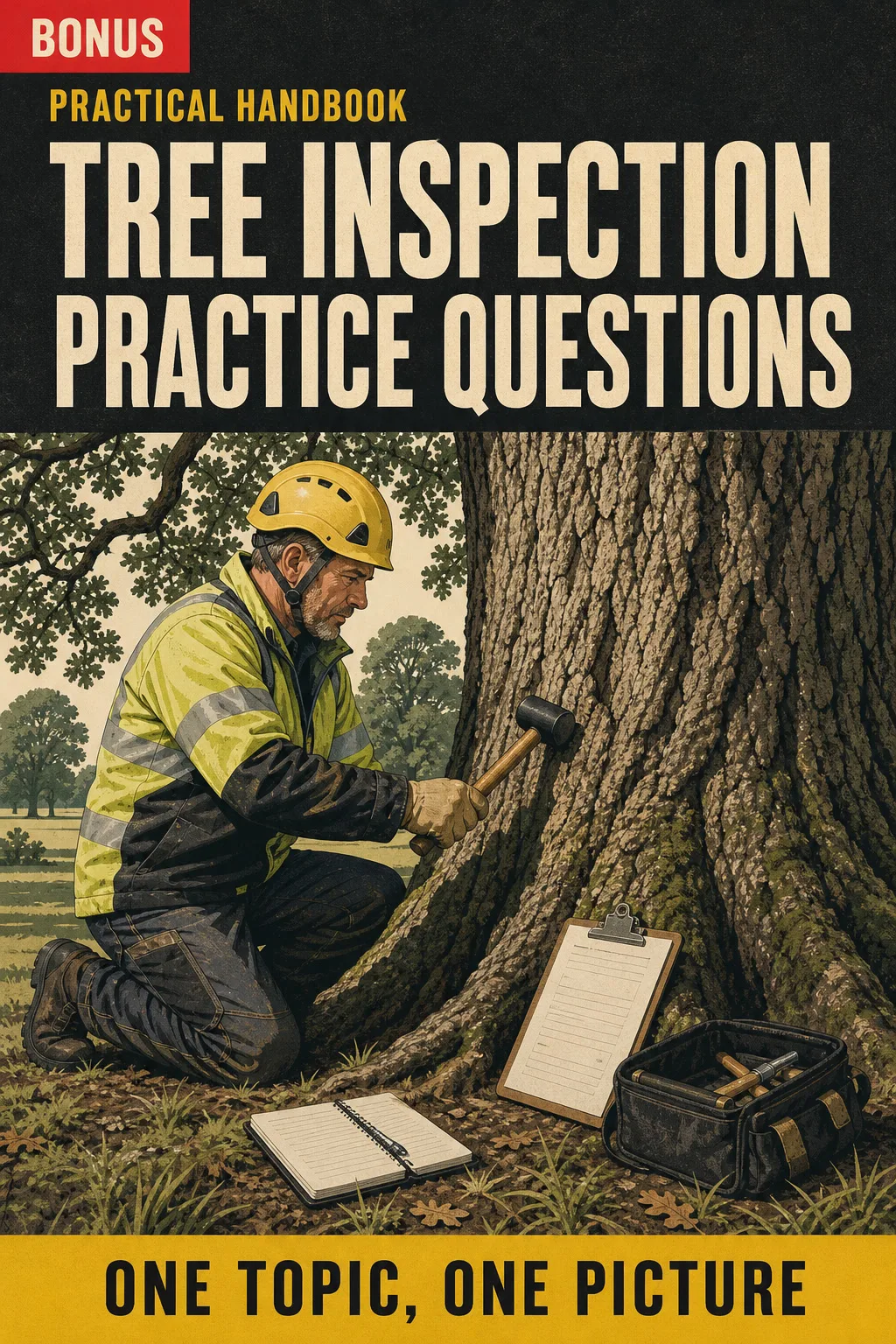
Tree Inspection Practice Questions

BONUS 1: «Tree Inspection Practice Questions»

Value on its own: US$ 17.90

Written and scenario-style questions with explained answers, so you find the gaps before assessment day, not during it.

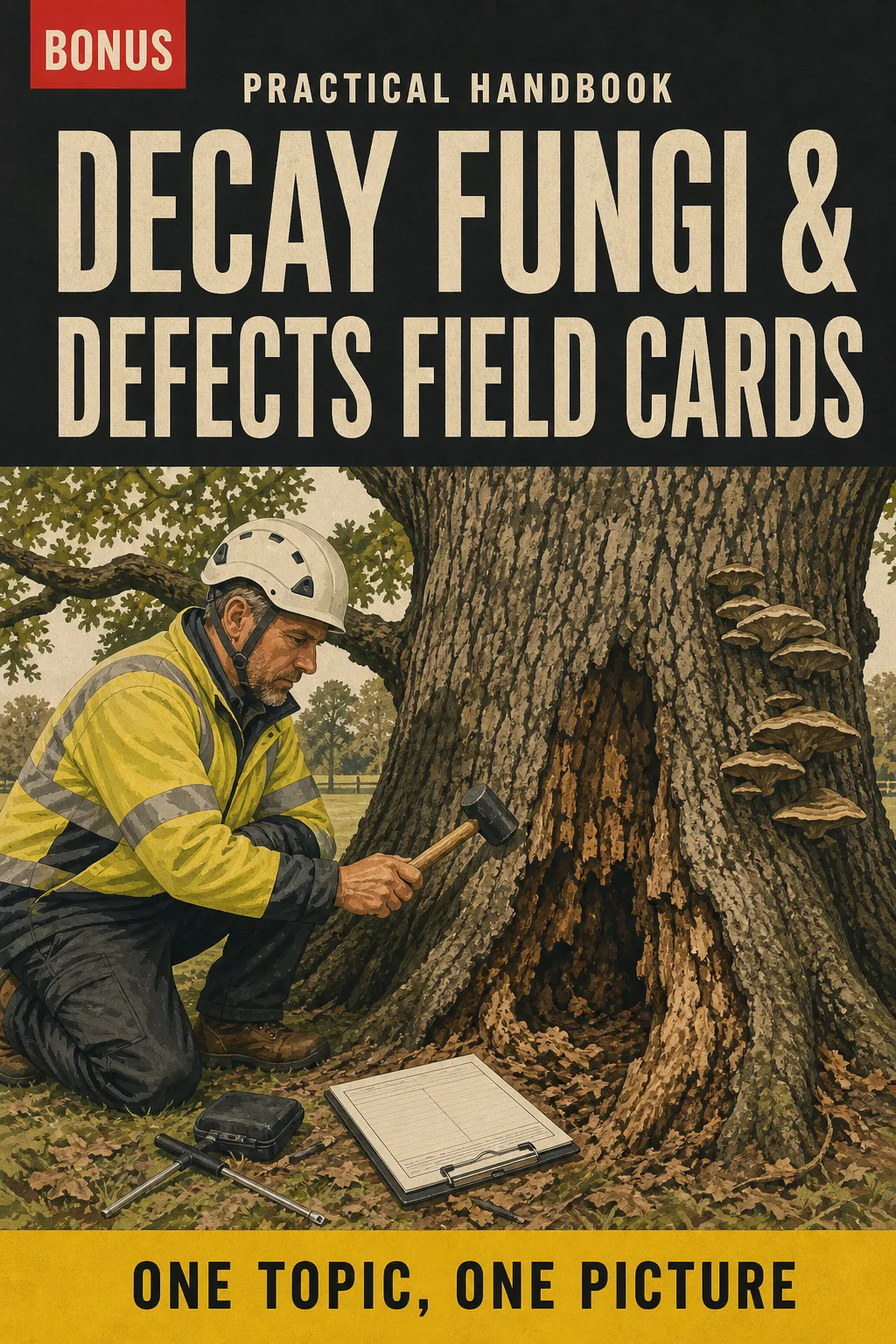
Decay Fungi & Defects Field Cards

BONUS 2: «Decay Fungi & Defects Field Cards»

Value on its own: US$ 14.90

Every key fungus and defect on a printable card with host tree, decay type and what it means, ready for the van or your pocket.

Tree Inspection Illustrated with 2 Free Books

  • Tree Inspection Illustrated: 67 illustrated pagesUS$ 63
  • BONUS 1: Tree Inspection Practice QuestionsUS$ 17.90
  • BONUS 2: Decay Fungi & Defects Field CardsUS$ 14.90
  • High-resolution PDF to printIncluded
Total value US$ 95.80
YOUR PRICE:
US$ 27
You save US$ 68.80
YES, I WANT TREE INSPECTION ILLUSTRATED FOR US$ 27

📄 This is a digital PDF book sent to your email: nothing is printed or shipped.

Secure purchaseEncrypted payment30-day guarantee

PDF by email: We email you Tree Inspection Illustrated as a PDF, together with the two free books. It's a single payment: no installments, no extra charges.

Who This Book Is For

You're on the tree inspection course

You're on the tree inspection course

Each topic of the course on its own page, drawn, so the theory finally has the same order as the tree in front of you.

Your assessment date is close

Your assessment date is close

The eight-step route, the fungi map and the law table to revise for a written paper with no notes, plus practice questions with explained answers.

You already inspect trees for a living

You already inspect trees for a living

A visual reference to print and keep in the van: defects, fungi with their hosts and re-inspection reasoning, one page each.

Everything You Get Today

US$ 95.80US$ 27
YES, I WANT TREE INSPECTION ILLUSTRATED FOR US$ 27

📄 This is a digital PDF book sent to your email: nothing is printed or shipped.

30DAYS
GUARANTEE

30-Day Guarantee

Try Tree Inspection Illustrated for 30 days, bonus books included.

We refund everything if the file won't open, if the book isn't what you see here, if you were charged twice or if the email doesn't arrive. Just email us.

You pay once. No subscriptions.

Frequently Asked Questions

Is it for me if I've worked with trees for 20 years?

Yes. It isn't a beginner's book: it puts what you already know into one fixed inspection order and in the shape a written assessment and a report need.

Where does the content come from?

From current UK legislation and guidance: the Occupiers' Liability Acts, HSWA 1974, Highways Act 1980, TPO regulations, wildlife law, NTSG guidance, BS 5837:2012, BS 3998:2010 and Forest Research / Defra plant health guidance. It's UK material, not a US system.

Is it official, and does it fit the Professional Tree Inspection assessment?

No. It's an independent illustrated study book, not affiliated with or endorsed by any awarding organisation, and it doesn't give you a certificate: that comes from your accredited course and assessment. What it does is cover the ground a professional tree inspection assessment asks for: the law and duty of care for the written paper, the inspection route for the practical, fungi, pests and pathogens for identification, and tree risk and the report for the scenarios.

Does it replace the course?

No. It's for studying and revising alongside your training. It doesn't replace accredited training, practice in the field or professional judgement.

Are the practice questions the ones in the assessment?

No. They're written for this book, in the style of written and scenario questions, so you can check what you know.

When and how does it arrive?

As a PDF by email, to the address you enter at checkout: the book and the 2 bonuses.

Do I have to pay every month?

No. It's a one-off payment.

Can I have it on paper?

Yes. It's a PDF you can print at home or at a print shop, whole or just the pages you want in the van.

How does the refund work?

You have 30 days. We refund everything if the file won't open, if the book isn't what you see on this page, if you were charged twice or if the email doesn't arrive: just email us.

Before You Close This Page

No more rereading notes that don't stick.

Included bark, Kretzschmaria, root plate heave: you see them drawn and that's it.

You arrive at the assessment knowing where everything is.

Drawings make studying faster.

The book is right below.

One-time payment: US$ 27 · Guarantee: 30 days · PDF by email

YES, I WANT TREE INSPECTION ILLUSTRATED FOR US$ 27

📄 This is a digital PDF book sent to your email: nothing is printed or shipped.